
If you’re new to investing, or if you’re not familiar with investing, terms like “margin trading” and “trading on margin” might sound like ultra-savvy investment speak you’d imagine being hurtled around trading floors and investment bank offices. And while those places certainly do use “margin” trading, it’s not out of reach for the ordinary investor. But, while available, it multiplies your market exposure and risk, and should only be used with caution and once you’ve mastered what you’re doing. And, for the average long-term FIRE investor, margin trading may entail more risk than you want to take on.
To begin with, trading on margin means nothing more than borrowing money to place trades. And here you thought it was some sort of fancy mechanism discussed over Wall Street lunches. The concept of margin trading is actually quite simple: if you can earn returns that exceed the interest you’re paying, then you’ve reaped additional gains. The difference between your investment returns and the interest rate is the “margin.”
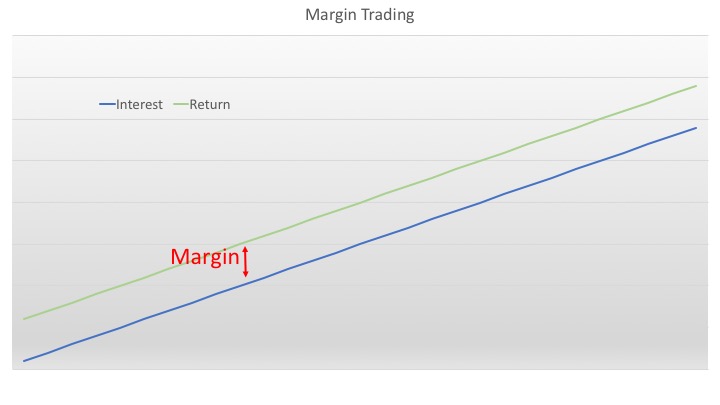
In prior posts, I’ve discussed the fact that in some cases, it can actually be beneficial to invest money rather than pay off debt or a mortgage. This is similar to margin trading in that, yes, you’re effectively using borrowed funds so that you can invest other funds. And, the same concept of gains applies in that the spread between the interest rate and investment returns (essentially still a “margin”) represents your actual gains.
But the example of purchasing stock rather than paying off a mortgage is a little different than the concept of trading on margin that we’re discussing in this post. Margin trading is a more direct transaction in which you borrow money from your brokerage for the direct purpose of purchasing securities.
So how does margin trading actually work?
Setting up a Margin Account
First, to trade on margin, you need to open a “margin account” with your brokerage. It’s similar to a standard account, but allows you to – you guessed it – trade on margin. Margin accounts have different disclosure requirements than standard brokerage accounts, which is why you have to enter them separately. If you needed a reminder, this should be the first sign that there’s additional risk associated with margin trading.
Once you have the margin account set up, you deposit money just like you would a standard brokerage account. Brokerage firms will require you to deposit a minimum amount of cash into the account, and then limit how much you can purchase with borrowed funds based on the amount you have in the account. The maximum amount of stock you can typically purchase with borrowed funds (i.e., “on margin”) is 50% of the purchase price of the stock. (Note: 50% is actually the maximum set by law).
This means that if you have $10,000 in cash deposited into your margin account, you can purchase up to $20,000 in stock (i.e., that $20,000 in stock is 50% on margin and 50% with cash). This initial amount is called the “initial margin requirement.” I’ll also note here that not all securities can be purchased on margin.

Maintenance Margin
Additionally, brokerage firms will set a “maintenance margin,” which is essentially a minimum value of your own equity that you have to maintain in your account. While the market value of your personal equity may dip below the initial margin requirement after you purchase shares, your personal equity cannot drop below the maintenance margin amount. FINRA sets the minimum maintenance margin at 25%, but individual brokerage firms may require more.
The purpose of the maintenance margin amount is to serve as a cushion so that you can repay the margin loan – after all, a brokerage firm isn’t going to let you trade with reckless abandon and take on all the risk. And because the maintenance margin is a percentage that depends on the market value of the account, if the market value goes down and your owned equity decreases, you may have to make up the difference.
If your maintenance margin is not met, the brokerage will issue a “margin call” that requires you either to sell some of your shares or deposit more cash to keep that cushion in place. Depending on the terms of your account, your brokerage may have the right to carry out the margin call on its own; for example, by selling shares in your account without you being able to do anything about it.
These are the simple mechanics of a margin account. Let’s work through an example to see how it plays out.
Examples
Say you deposit $50,000 into a margin account with an initial margin of 50% and a maintenance margin of 25%. The first $50,000 of stocks purchased is not considered trading on margin because you’re using your deposit to purchase them. But, after you use up your $50,000, now you can trade on margin, and with a 50% initial margin, you can purchase up to $100,000 in shares. That $100,000 in shares is comprised of the $50,000 you purchased with your deposit plus $50,000 on margin. With a $100,000 market value, you’re in compliance with your maintenance margin, which requires that your personal equity be at least $25,000.
Now, if the market value of the $100,000 purchase drops to $60,000, the value of your owned equity drops to $10,000. This is because you borrowed $50,000, so the value of your owned equity will be (account value [$60k] – borrowed amount [$50k]). With $10,000 of equity against a $60,000 market value, your share of owned equity is about 17%, which is below the 25% maintenance margin. So you may get a margin call to make up the difference between your equity value of $10,000 and the minimum equity amount for a $60,000 market value. That minimum equity amount would be about $16,700, which is 25% of $66,700. (Remember that when you deposit money, the total account balance goes up, but the loan is still $50k, which is why it’s not as simple as contributing $5k for a $15k equity share against a $60k market value).

Margin Trading in Action
Ok, so those are the mechanics. But let’s talk about why people trade on margin. Leaving aside maintenance margins for the moment, say you’ve deposited $50,000 in cash and purchased shares worth $100,000, essentially doubling your exposure.
If the stock you purchased increases by 10% on the year, you’ve essentially doubled your returns. Instead of a market value increase of $5,000, you’ve earned a market value increase of $10,000. If the annual margin interest rate is 4%, you sell your shares for a $10,000 gain, and pay back $2,000 ($50k x 0.04), your remaining gain is $8,000. By trading on margin, you’ve earned an additional $3,000 that you wouldn’t have earned had you only invested the cash you had. Essentially, what you did was borrow $50,000 with a 4% interest rate, saw a market value increase of 10%, and pocketed the difference of 6%.
Typically margin trading is not long-term. A good chunk of, if not most, margin traders use margin for quick turnaround, but whether you use margin for a year or a few hours, you see the point – you’re able to increase your market exposure and potential returns by borrowing money to purchase more shares.
Hopefully you can also see the risk. Not only are you taking on additional upside, but you also bear the risk of additional downside. Take the same example above, except now the stock goes down by 10% on the year. If you hadn’t traded on margin, you would have lost $5,000 ($50,000 – $45,000). But, because you traded on margin, you sell for $90,000 and have to pay back $52,000 (the borrowed $50,000 plus the 4% interest [$2,000]), leaving you with $38,000. Not only did you lose additional market value, but you paid interest as well. So you’ve more than doubled your losses from $5,000 to $12,000.
You might be asking: don’t we think that the market increases by about 6% – 10% annually, meaning that any margin interest rate lower than that nets a gain? Wouldn’t that mean that if I can get a long-term margin rate of less than what I expect long-term growth to be that I’d come out ahead?
And the answer is, maybe, but probably not. Think of it this way: if this were a simple way to create low-risk additional gains, wouldn’t everyone be doing it? Hint: they’re not.
Because of initial margin requirements and maintenance margin, volatility can create significant risks. In a non-margin account, your market value will go up and down over time, and while it can be painful to watch when it goes down, you won’t owe anybody anything. Moreover, when your market value goes down in a traditional account, you’re not obligated to sell any shares – you can continue to hold on to them and wait for the market value to return (hopefully).

You may not have that option with a margin account. If the maintenance margin is breached and you don’t have cash sitting around to make up for a margin call, the brokerage may sell off some of your shares, forcing you to take losses at a time you don’t want. Similarly, as you can see from the example above, when market value dips, margin increases your losses, which can make it more difficult to weather downward volatility.
It’s for this reason that you don’t typically see long-term margin trading. And this is the difference between margin trading and not paying off your mortgage so you can invest more. There are no margin calls on your mortgage, meaning you don’t have to take losses.
Moreover, margin rates are higher than long-term interest rates like mortgages and even other debt. Margin rates fluctuate with the market, but because they fall into a higher-risk category, they fetch a risk premium over something like a mortgage rate. As an aside, this is one reason why low interest rates can result in a higher stock market value – as margin becomes cheaper, more traders use it, increasing demand and price for stocks.
For the FIRE Investor
For your average FIRE investor, margin trading is probably more risk than you want to take on – especially if you have a long-term growth strategy. If you’re trading on margin, assuming a conservative long-term annual growth rate of 6% is no longer a good bet. Margin adds a layer of complexity that’s more difficult to predict. And if you’re trading on margin, you’ll typically want to watch your trading more closely to monitor and determine whether to sell. If you’re working full time, you may not have the ability to do this.

What’s more, margin traders might lean toward more volatile stocks that produce a more significant spread. If a trader thinks a share is poised to jump by several percentage points more than the prevailing margin rate, they may take the risk. But shares that jump like that tend to be more volatile to begin with, which entails greater risk and needs more active monitoring. Long-term, steady growth stocks tend not to be as popular for margin trading. Not that it’s impossible, just that the predicted spread might be so small that it’s not worth taking the risk.
Not to dissuade anyone who likes more risk. There are plenty of FIRE investors who reached their goals with aggressive trading strategies, including by trading on margin to enhance gains. Just know that it comes with additional risks and, perhaps more than anything, requires you to know what you’re doing, dedicate the appropriate amount of time, and execute your trades wisely.
But if you’re taking a buy and hold long-term strategy toward FIRE and you’re otherwise fully engaged with your job most of the day, margin trading is probably something you want to avoid.
 The FIRE Investor's Guide to Early Retirement