

Hopping around the internet lately, I read several articles about the anticipated rate of return in the stock market for the coming years and couldn’t help but notice a significant discrepancy among them.
On the one hand, there were plenty of rosy articles claiming that it’s both not absurd and in fact entirely prudent to assume a future long-term return of approximately 8-10% per year. Then there were the articles consistent with my own opinion that about 6% is a wise, conservative return that isn’t at odds with historical returns and what we might expect going forward. And then there were the doom and gloom pages, stretching high and shouting down that it would be unwise to expect any more than 2-3% tops. The last of these, at times, pointed out the absurdity of the assumptions made not only for traditional retirees, but those in pursuit of FIRE, who make assumptions like 6-10% returns to validate their calculations for early retirement.
Fair reminder that my opinion remains the same: I think that assuming an average return of about 6% per year is appropriate for a stock-heavy portfolio. And a reminder of what I mean by “average.” I mean that in 15 or 30 years, if you look at the total return on investment in your portfolio, and then divide that by the number of years since you started, the annual return will be about 6%. This means that along the way there will be years when the return is higher and years where the return is lower (even negative at times).
I’m also accounting for compounding returns when I say 6%. The difference here is minimally important since we’re talking long-term returns, but let’s clarify. If you start with $10,000 and in year 1, it goes down by 50% and in year 2, it goes up by 50%, technically the “average” rate of return for those 2 years is 0%. But you won’t be back at $10,000 at the end of year 2, as you would with a true 0% return. After year 1, your balance would be $5,000, and then after year 2, your balance would be $7,500. The reason for this is that the 50% gain on year 2 is compounded, i.e., it’s measured on the year-end balance of the prior year (i.e., a 50% gain on $5,000). So after two years, you’re actually down 25% even though the average of the rate of return is 0%.
When I say a 6% return on average, I’m not talking about an average rate of 6%, as this would not take into account this phenomenon. Rather, I’m talking about total return averaging about 6% when looking back. To take it one step further, I’m not saying that returns will be 5%, 7%, 4%, 8%, 10%, 2%, 6%, which average to 6%. I’m saying that if you start with $10,000, contribute nothing annually, in 10 years you’ll have $17,908. At the end of year 10, with $17,908 of market value, you can look back and say that you earned about 6% per year, even if within those years, the actual year-end return was all over the place.
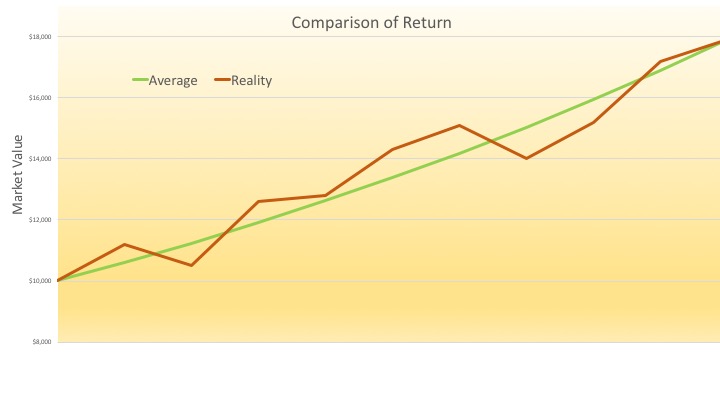
What about the concern that this 6% compounded return is delusional? Normally I’d summarily reject an assertion that something I’ve said is delusional (which is perhaps itself delusional), but because we’re talking about something this important, let’s give it some thought.
Historically, the S&P 500 has returned about 9-10% per year over its lifetime, not adjusted for inflation. That is, the stocks in the S&P 500 index have gained a nominal compounded value of 9-10% per year. If you adjust for inflation, assuming about 3%, you’re seeing returns of about 6% in real gains. As I’ve explained before, I think it’s more realistic to apply inflation to your calculated budget than to adjust your returns, which ideally gives you a better idea of the amount of nominal dollars you need to cover your anticipated expenses.
But I still use 6% non-inflation adjusted for returns. Does that mean I’m actually assuming a 3% real return, in line with the articles I called doom and gloom?
Not quite. For one, accounting for inflation the way I do assesses the impact on estimated costs, rather than overall returns. So you end up seeing a higher amount of nominal dollars because we’re not reducing the amount of dollars in your possession, only increasing the amount you need to spend. This effectively reduces the value of those dollars. Admittedly, however, this method doesn’t necessarily take into account if you decide to spend more than what you’ve budgeted – in that situation you’d have to look at the real, not nominal costs. For this reason, it’s not as simple as taking 6%-3% = 3%.
But, assuming a 6% non-inflation adjusted return, plus adding inflation to anticipated costs is not quite the doom and gloom of assuming a general 3% return. When I read articles predicting a 3% inflation adjusted return, they’re often talking about a portfolio comprised purely of stocks, as in, a very aggressive, risky portfolio. When I say 6% long-term, I’m building in a good amount of conservatism to that. I don’t believe 6% is accurate if you’re 100% invested in equities – but I couldn’t tell you what that return would be because there’s more risk. For me, 6% means that, during the more aggressive investment years, the portfolio is mostly (90%) equities with some other less-risky assets built in (bonds, muni bonds, cash, etc.).
I’m also assuming that you shift some of that in the later years of retirement to lower your risk. However, I’m not assuming that you take as conservative of a position as you might find online as the typical wisdom (i.e., 30% stocks as you retire). Doing this will lower your returns, and if you need to stretch returns due to an early retirement, you won’t have a chance of making it if you’re too risk-averse. Rather, I’m still assuming that you maintain a healthy allocation of stocks (maybe 60-70%) on the theory that even if you’re actively spending your assets, you still don’t need it all at once, meaning you still don’t have an immediate short-term outlook.

All this is to say that, whether you agree with my method, or you agree that it’s better to adjust your returns to “real” dollars to see how much purchasing power you’ll have in the future, you have to pick a method and stick to it. You can read endless articles on the different return assumptions and how to account for inflation. But if you’re truly dedicated to pursuing FIRE, you have to develop a budget, calculate how much money you have and need, and apply an expected rate of return and inflation rate.
Remember, if you assume that your returns will be higher (which is fun to see on a spreadsheet), you’re definitely taking on greater risk. If you’re assuming your returns will be lower to build in conservatism, you might end up saving more (i.e., working longer) than you need and undermining the whole point of FIRE.
But ultimately it’s up to you. We can’t really predict the future with any accuracy (duh). So the best we can do is look back at how the market has behaved historically and try to estimate by assuming that things will more or less remain constant. It’s my belief that 6% return and 3% inflation is about consistent but errs conservative. You might think that’s either too cautious or too risky.
But one way or the other, you need a number. Pick one and go with it. Adjust if you must, but don’t drive yourself into a perpetual obsession because you’re reading too many different opinions (like this one). Use your best judgment according to the information available. It’s a critical step to be on your way to making your retirement goals happen.
 The FIRE Investor's Guide to Early Retirement