

Whether you’ve actually made your first purchase of a share of stock, or have almost done it, or have simply researched it, you may have seen there are different ways of placing orders to purchase shares. In particular, you may have seen the terms market and limit as options to fill your order. Even if you haven’t heard of these, they’re good terms to know, because they can impact the price at which you purchase or sell shares. In this post, let’s talk about the different types of orders you can place to buy or sell stock.
Market Orders
On most online brokerage platforms, a “market” order is set as the default, and indeed, this is probably the most common way that casual traders, including FIRE savers, purchase shares of stock. A market order essentially tells the brokerage platform to fill your order at the next and best available price it can obtain on the market.
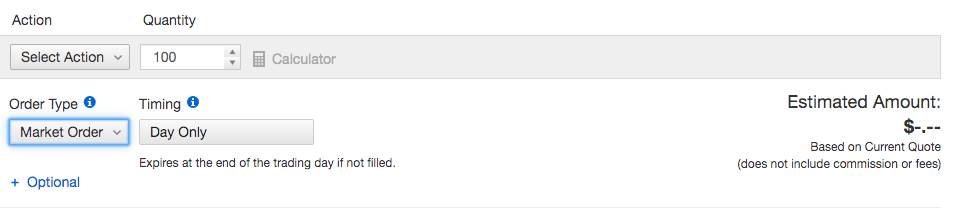
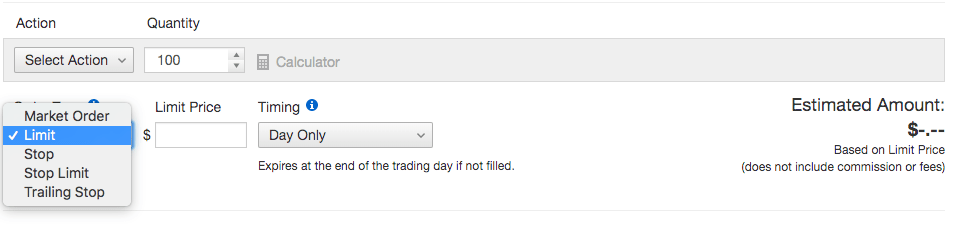
An example is best. Say you want to purchase 100 shares of XYZ. You pull up your online brokerage platform, find XYZ, and enter 100 shares. You’ll probably notice that the platform will show you the price XYZ was trading when you looked it up – and on some platforms, the price will continue to move as you sit there and ponder the transaction. Let’s say you see it trading around $50. After you enter 100 shares, the screen says it will complete the trade at an estimated total cost of $5,000.
Remember from the discussion of bid/ask prices that stock that does not simply sell like groceries at the grocery store. Share prices are not fixed; rather, they continually fluctuate during the trading day.
When you hit “confirm” on your market order, the broker will execute the order at the best price it can get for the number of shares you want to purchase. The market will search for the first seller offering shares of XYZ at the lowest price it can find. The broker will do this until it fills your order for 100 shares of XYZ. If the seller with the lowest available price is offering 100 or more shares, the market will execute your order by purchasing that seller’s shares and complete the order. If the seller with the lowest available price only has a portion of the shares you’re looking to buy, the market will purchase that seller’s shares and then move to the next available price. The exchange will continue to do this until it finds you 100 shares.
Once the market matches you with 100 shares, you’ll see in your transaction history that the order has been filled. You might see that all 100 shares came in at the same price, or you might see, for example, that you got 50 shares at $50.01, 25 shares at $50.02, and 25 shares at $50.03 – or any permutation of this sort.
This, in essence, is what a market order does – it fills your order regardless of price. When you place a market order, you’re saying to the broker to get the shares you asked for at any cost. This generally guarantees that you’ll get the shares you’re looking to buy and that you’ll get them as soon as possible. If you’re purchasing stocks of major companies trading on markets like the Dow or Nasdaq, and you’re doing so during the trading day, a market order will likely complete in a fraction of a second, with a price that’s pretty close to the prevailing price you saw when you placed your order.

You can also place a market order when you want to sell shares, and the same thing happens – the exchange matches you with buyers offering the highest price it can get until your order is completed.
Market orders are not limited only to stocks of individual companies either. You can essentially place a market order for anything that trades actively, including ETFs, futures, etc.
For most long-term traders, market orders are the best option to buy securities when you have the cash available to do so. While you’re never sure of the exact price at which an order will fill, if you’re trading stocks of major companies or index-tracking ETFs, you can be fairly sure that the order will execute near the price you’re seeing when looking up the shares. If your strategy is long-term buy and hold, a difference of a fraction of a cent is fairly minimal in the long run; plus, you have to make sure you purchase the stock – if you try to hold out for a specific price, you could miss some growth opportunity.
A Word of Caution

One word of caution about market orders is that you only want to use them during the trading day, and in fact, most brokerages will caution you (or restrict you) if you try to place one when the market is closed. The reason is that if you place a market order in the off-hours, the exchange will execute the order at the next available price when the market opens. As you may notice if you check the markets regularly, the first few minutes of trading are the most volatile – especially right when the markets open. In the first few seconds of trading, there can be huge swings as the market accounts for everything that happened overnight.
If you place a market order when the market is closed, with the order set to execute when it opens, this is one of the few times when you’re taking the risk of a big swing from the price you’re seeing when you place the order. For example, if XYZ closed at $55 the previous day, and you place a market order in the overnight hours to fill at market open, you can’t be assured that you’ll get a price around $55 because the stock could move significantly when trading starts. To minimize the risk of major swings, it’s best to place market orders during the trading day, and make sure they expire at the end of the day if not completely filled (which they usually do by default). This way, you won’t be hit with a big surprise if the stock swings the following morning.
Limit Orders
A “limit” order is mostly based on the price at which you’re looking to buy or sell. Whereas a market order will focus on getting you the quantity of shares you asked to buy or sell, with a limit order you set the price you’re willing to accept and the exchange will wait until it can execute your trade at that price.
Let’s take the example of purchasing XYZ. To place a limit order, you have to specify both a price and a quantity: say you specify $50 per share for 100 shares. When you do this, you’re placing a bid of $50 for 100 shares. Once you hit confirm, unlike a market order, the trade may not execute right away. Instead, the exchange looks for a seller willing to sell shares of XYZ at $50 per share. The exchange won’t execute your order at $50.0001 – it’ll wait until the shares become available at or below the price you’ve provided.
Depending on how the stock was trading when you placed the order, it may take some time for your order to be filled. If it was trading around $50 when you placed the order, it may not take too long to find a seller willing to sell 100 shares at $50. However, if the stock is trading around $55 when you place the order, the market price will have to come down a bit before you find a willing seller.
When you place a limit order, the entire order may not fill at the same time. If the exchange is only able to match you with a seller asking $50 for 50 shares, it’ll fill that portion of the order but keep the remaining limit order for 50 shares outstanding until it fills. The exception is if you specify that you only want the transaction to execute if it can fill the entire order at once. If you do this, however, that might add further delay to the timing of the transaction.

Limit orders also work when you’re trying to sell. When you place a limit sell order, you’re specifying a minimum price you’re willing to accept for the number of shares you specify. You also have the option of allowing the order to execute partially, or you can specify that it should only execute if the entire order can be completed at once.
In addition to setting the price and quantity of shares, a limit order allows you to specify a time frame for the order to remain open. The most common, and often default time frame, will be to leave it open until the order executes. This gives you the option of waiting for the right price to come. Be aware, however, that this does not necessarily mean the order will stay open indefinitely. Some brokers will close an open limit order after a specified time frame, typically a year.
The other default timing option you’ll see is to keep the order open during the remainder of the trading day, meaning if your order doesn’t execute by 4 pm ET, it’s canceled. Most online brokers are fairly flexible too, allowing you to set a precise time frame to keep the order open.
Limit orders are a good option when you want to control the price at which you buy or sell. Now, as discussed above, if you’re trading liquid stocks of huge companies on the major exchanges, using market orders is generally fine, as you’ll likely be able to execute a transaction near the active price you’re seeing when you search for the stock. Limit orders present a viable option for less liquid stock or more volatile stocks, because allowing you to set the price means you won’t take an unexpected hit due to a large price swing.
Limit orders are also a good option if you want to speculate that there might be a dip to buy or a spike to sell. For example, if XYZ is a good, solid stock with strong growth potential, but you don’t want to buy in at the current price, you can set a limit order at some amount below where it’s actively trading. If the price takes a dip, you might be able to pick up shares at a lower price and hopefully benefit when the share price recovers.
On the flip side, if a stock you hold is starting to look like it’ll take off, you might set a limit sell order at a speculatively higher price, and if the shares reach that price, you’ll be able to capture some gains. For example, if XYZ is now trading at $50 and has been going up for the past few days, you might set a limit order to sell at $60. If XYZ continues to ascend, you’ll be able to capture some gains if it makes it there.
For the FIRE Investor
This use of limit orders like this is generally for more active traders. If you’re investing toward FIRE or retirement generally, you likely don’t want to buy and sell too often, as you lose the benefit of long-term buy and hold – in addition to incurring capital gains taxes. Moreover, if you’re placing speculative limit orders, it means you’re probably tying up some cash to allow those orders to execute. If the order doesn’t execute, then you’re leaving cash in your account uninvested, missing the potential for gains. So there’s definitely some risk in doing this.

For the FIRE investor, limit orders are most helpful if you’re buying a less liquid security and want to control the potential for price swings due to volatility. But generally speaking, for most FIRE investors, using market orders to buy liquid stocks is a common approach. When you’re buying liquid stocks or ETFs with significant volume on a major exchange, and as long as you’re placing those orders during the trading day, there’s minimal risk of volatility impacting the price you pay.
Of course, the market is still subject to volatility itself, and there’s always risk in investing, but the point is that even if you place a market order, the price you’re seeing when you get a quote is likely the price at which you’ll be able to buy or sell – at least for a few minutes. Market orders are also the best way to ensure that your order is filled and your cash is invested, which is the most important thing for a long-term investor.
Hopefully this post helps you understand how orders are filled. In a future post, I’ll talk about a related topic that you may be familiar with – the stop loss.
 The FIRE Investor's Guide to Early Retirement