
Let’s say you decide to pursue a FIRE strategy. You start setting aside a solid portion of your income and invest in what you believe are good long-term growth prospects. You do this for a few years, and between the principal you’ve deposited and some growth, you’re starting to build a fairly decent-looking portfolio. Maybe the prospect of retiring early starts to become tangible as you start to see what it’s like to have money available other than income from your day job.
And then you start to think, “do I really need to be working right now?” “Why am I formatting spreadsheets or whatever when the market’s doing the work for me?” Or something like that. But then the real teaser comes. You might think, “what if I could just trade stocks for a living like some people do? It’s sort of worked out so far, maybe I can just do this full time?”

This is where you need to pause, take a breath, minimize the spreadsheet for a moment, and reflect. Because yes, there are people who make money trading stocks to the point where they do it for a living. Some people are indeed very good at it. And of course you have those who have experienced some success and decided to flaunt it – maybe you’ve seen nonsense they put on the internet boasting about trading while sitting in an aggressively gratuitous sports car. But before you throw away a job that pays you, and probably your health insurance, let’s talk about day trading, which is one of the methods that people who’ve chosen to trade stocks for a living go about their day.
Day trading falls among the approaches that active stock traders take toward making short-term income. I’m focusing on “day” trading because there are other methods too, including swing trading, which is slightly more long-term, and then of course there’s buy and hold, the stalwart of the FIRE investor. Day traders generally close out their positions by the end of each trading session. If you’re not closing out before the markets close, you’re typically not “day” trading.
The other attribute that distinguishes day trading is that it generally is not based on the underlying fundamentals of the stocks being traded. That is, a day trader doesn’t do research hoping to find a solid company with good long-term profitability. Nor does a day trader try to find stocks that appear to be undervalued based on the company’s prospects, and purchase shares hoping for an upward swing. These approaches are more common for swing traders and long-term investors. Day trading, in contrast, is based mostly on patterns in a stock’s movement over short periods.
As I’ve addressed in other posts, most of the major stock markets move due to the actions of large, institutional traders and their algorithms. At its most basic level, what day traders do is look for patterns that emerge in these movements and trade between them. That’s to say that day traders don’t buy and sell in volumes that significantly impact a stock’s price, but instead try to ride the movement of stock by predicting how it’ll move.
I won’t get into the gory details of the patterns day traders use to predict movement of a stock’s price over the course of the day. But I do want to discuss one way day traders assess price movement, because this is the part long-term investors might see and wonder what traders are looking at.
In particular, I’m talking about “candlesticks.” Candlesticks are interesting ways to plot the course of a stock price’s movement over a specified period of time. You’ve probably seen them as an option to view price changes on your online brokerage platform if you’ve ever checked stock prices mid-day. And half of the pictures I use on this site have candlesticks showing stock price movement. They’re interesting to look at and a welcome diversion from the typical line plot of price movement. Here’s an example of two candlesticks:

You can see there are two candlesticks in the above graphic: a green one and a red one. I’ll note that on some charts, instead of green and red, they’ll be hollow and filled-in with black, respectively. But I like the colors, so let’s use those.
The green candlestick on the left shows us a few important things. The fact that it’s green (or hollow) shows that over the designated time period, the price went up. You can see that in the fact that the opening price is below the closing price. So at the beginning of the period, the prevailing market price started at the opening price, moved around over the course of the selected time period, and then at the end, finished at the closing price. The lines coming out of the top and bottom of the candlestick show the range of price movement over the time period. You can see how low the price went and how high the price went before finally settling on the closing price.
The red candlestick shows us the opposite situation. In this one, the stock declined over the time period, starting at the opening price, moving around, and then ending on the closing price. You can see that it also had some movement, shown by the high and low points sticking out of the body of the candle on both the top and bottom.

By “time period” in the above paragraphs, I mean that you can select how long you want a candlestick to show a stock’s movement. So the candlesticks can be one-minute, five-minute, one hour, one day, etc. If, for example, the above candlesticks are for a five minute period, then all that action would have occurred in five minutes.
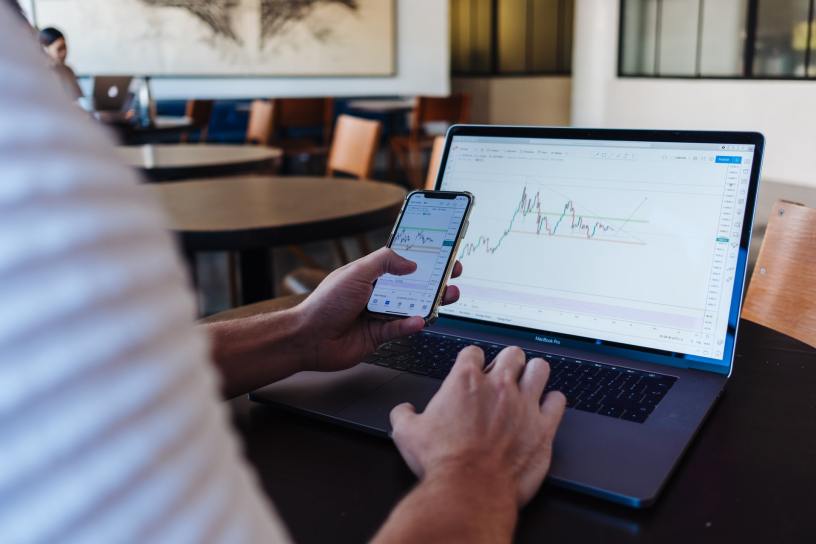
I show the above example as relevant not only to day trading, but to anyone looking at stock prices. Candlesticks show how prices moved, and how big the range of prices was during the time period you select. For day traders, this information is vital to their predictions of how the stock will continue to move, and often forms the basis for how day traders place their trades. So, a day trader might look at a chart with five-minute candlesticks and look for patterns within the movement indicating the stock’s next move. Here’s what a day trader might sit and look at:

A day trader will look at how the price is moving, up or down, the length of the tails (showing the range of prices), and whether any patterns are emerging. In addition to the candlestick chart, day traders also heavily focus on volume of trading. Volume is often indicative that a particular move up or down is not a fluke, but is part of concerted market movement in one direction or the other. Volatility is another feature of stock movement that day traders follow, searching for a stock that will move enough so that it’s possible to make a profit that’s worthwhile.
Day traders for the most part don’t only seek to make profits with stocks that are increasing in price. Becoming a profitable day trader often involves learning how to master shorting stocks to profit whether the market is moving up or down. This is part of the reason day traders are not particularly concerned about the issuing company’s profitability or long-term prospects. Day traders are more focused on short-term movements up or down rather than whether the company’s stock is a “good” buy for the future. Incidentally, this means that day traders tend to stay away from blue chip stocks. Blue chips tend to be those with solid future prospects, and as a result lack the volatility needed to capture a short-term profit.
I’m not a day trader, so I’m not intimately familiar with the patterns day traders use. You can research those separately, and you’ll find a whole bunch of different approaches, with each trader swearing by their own. And the patterns all end up with their own – sometimes quirky – shorthand names. It’s actually pretty interesting, and if you gain some understanding of the approach, sort of fun to follow (if you’re into that…).
Becoming a day trader requires mastering a variety of other aspects of trading, and understanding how a stock price is moving and where it’s likely to go. Understanding things like bid and ask pricing, the difference between market and limit orders, and using tools like stop losses to capture gains are critical to day trading.
The point is that day trading is not a skill acquired overnight, despite what some people on the internet might have you believe. It takes time to understand the meanings of different patterns, how to pick the right stocks to watch (you can’t watch them all at once), recognizing when a pattern is forming, executing the trade, setting an appropriate stop loss to mitigate loss and capture gain, and watching the stocks when you have an open position.

And of course, you not only have to predict the right time to buy a stock, but also when to sell it. There’s mastery required on both sides of the transaction, and there can be significant variance in how long a position is kept open. Some can be for a matter of minutes, while others may be for a few hours. Day traders need to find a balance between getting out too soon or too late in an attempt to maximize profit on a trade.
Of course, any seasoned day trader will tell you – there are losses. All the time. And to become a trader, you have to learn how to leave emotion out of it, especially the instinct to start taking on riskier positions to recoup losses. As you might expect, that can often lead to even more losses than if you had stopped, reset yourself, and looked at future trades dispassionately and objectively.
For most day traders, it’s not something they picked up in a day. Many dabble for a time and then switch to full time when they feel they’ve mastered it enough so that they won’t tank their savings in a few days. Others full-on quit their day jobs to learn how to day trade for several months before actually doing it in the real world. You probably wouldn’t be surprised to learn that there are a number of simulators available where you can practice day trading without risking real money. This is where many day traders start, and they don’t stop after they start real trading – some use it like continuing education to keep their skills sharp or to reflect after suffering losses.
Day trading also requires the right equipment and platform. A FIRE investor placing a market order through an online broker is a much different process than a day trader executing rapid-fire buy and sell orders. For day traders, slivers of cents matter. When a FIRE investor plans to hold a stock for 30 years before selling it, a difference of 1 or 2 cents is not significant, but for a day trader executing hundreds of trades per year, it adds up fast. Day traders often use keyboard shortcuts and other tools to execute trades with minimal delay, all in the interest of squeezing out the tiniest margins. And they use more complex trading platforms that show more real-time data and execute trades quicker than your average online broker.
For the FIRE Investor
Suffice it to say that the experience of buying and selling stock differs quite a bit between a day trader and a long-term buy and hold trader like a FIRE investor. The experience of a FIRE investor logging into an online broker, searching around for a security every few weeks, and placing a market order at your leisure is not the same as what day traders do.
Day traders process troves of rapidly moving data over the course of a single trading session. They don’t sit and let the market do the work for them – day trading is a job in itself, and not an easy one. There’s significant risk to doing it, and day traders have to be prepared to take losses time and time again. It takes a solid constitution, an appetite for risk, and an ability to move quickly. And yes, some people do get very good at it, much in the way people can generally become adept at their jobs.
But if you’ve seen some growth in your portfolio over a few years and suddenly think you’re a stock trader, you’re probably not. Trying to day trade without learning how to do it will almost assuredly net you some losses. And if you think I’m overstating the risk, try to see if you can make a profit on a single stock one day. Take a $100, log into your online broker, pick a stock, watch the candlestick chart, and see if you can make a gain of 5-8%. The first time you sit and stare at the candlesticks will quickly enlighten you.
Even picking the right stocks to watch is not an easy task. Day traders don’t watch the entire market hoping to stumble on a volatile stock showing a pattern. The approach is far more methodical, as most day traders will prepare a list before the trading session of stocks to watch. It takes some effort to find stocks with the right combination of volatility and volume that have the potential to net the trader profits over the trading session by capturing short-term price swings.
All of this is not to dissuade anyone from day trading. It’s certainly an option, but it requires appropriate dedication. Rarely does day trading become a successful job you do on the side without properly learning how to do it.
I will say this – reading about day trading is a good way to learn a great deal about stock trading generally, and it can be interesting. Even for long-term buy and hold FIRE investors, it’s nothing but beneficial to be knowledgeable about how the stock market works. Hopefully this post has somewhat demystified stock trading, even if it did nothing more than confirm that long-term buy and hold is the approach for you.
 The FIRE Investor's Guide to Early Retirement