
In the realm of economics, inflation is probably one of those terms that people know and have at least some level of understanding. After all, the concept is simple. Over time, inflation causes prices to rise, meaning that a dollar twenty years ago, a dollar now, and a dollar twenty years from now won’t all be able to purchase the same amount of things. Of course, a dollar won’t really get you anything, so why even use that as a point of comparison?
Nonetheless, this rudimentary understanding is true. And it’s extremely relevant because it means the same quantity of money today will lose purchasing power over time. There are two perspectives from which to view this:
- The same amount of money buys you less over time. $1,500 used to get you a one-bedroom apartment, and 10 years later, $1,500 gets you a studio at most.
-or-
- You have to spend more quantity of money to get the same thing. A one-bedroom apartment used to cost you $1,500, and 10 years later that same apartment costs $2,000.

In the 1980s and earlier, inflation in the U.S. was much higher than we’ve seen for the last 30 years or so. Back then, it wasn’t uncommon for inflation rates to hit 6-7% or more. But since then, the Federal Reserve has become more aggressive keeping inflation in check, setting about 2% as the maximum target. However, since the 2008 recession, inflation has been even less of a concern, with inflation rates hovering at historic lows despite sustained economic growth. I won’t get into the theories on why that occurred, but will say that you wouldn’t be out of place if you felt like you didn’t hear too much about inflation during the early to mid 2010s. Although, as the latter half of 2021 rolled around, inflation started popping up in the news again as it reached the 6% mark. 2021 showed that inflation definitely still exists in the US.
And let’s get this out of the way – we’re not talking here about hyperinflation. Hyperinflation is what you know of from Venezuela, Zimbabwe, Poland, and a few other places since World War II. Hyperinflation is basically high inflation that happens quickly, and where the currency essentially loses its value at a very rapid pace. These events are due to a range of economic and political issues, and while they can always occur, they’re still outliers. For the average long-term investor in most of the world, hyperinflation is a minimal risk.
Types of Inflation
There are two primary causes of inflation, known as demand-pull and cost-push. Let’s talk about each one because it’s helpful to understand why inflation happens.
Demand-pull: Demand-pull happens when demand outpaces supply in the economy. Essentially what this means is that consumers are flush with cash and looking to spend it, so much so that supply can’t keep up. As a result, prices increase because sellers can sell their goods for more money and people are willing to pay it. In theory, as prices increase, supply and demand meet each other and the market settles. Demand-pull happens when there is sustained economic growth and low unemployment, which leaves people with more money.
Cost-push: Cost-push occurs when the prices of inputs increase, whether materials, labor, etc. As a result, prices of production rise, which itself increases overall prices. Additionally, as the cost of production rises, supply tends to decrease, which also raises prices. Cost push is less about consumers having money to spend, and more about the impact of constraints hitting supply like fewer materials or workers. Cost push can occur for many reasons, including where there are shocks to supply chains.

Of these two, the Federal Reserve exercises the most control over demand-pull inflation. By raising interest rates, the costs of raising capital increase (loans become more expensive), which slows production and spending. With consumers less flush, demand settles and catches up to supply, relieving the upward pressure on prices.
And one more thing you might be asking: why let there be inflation at all? The answer is that inflation isn’t all bad. It’s an indicator that the economy is growing, wages are rising, and people are employed. The only way to crush inflation entirely would be to keep things stagnant by allowing unemployment to stay high, suppressing wages, and keeping interest rates high – all things that reduce the amount of money people have to spend. This is absolutely the opposite of what makes up a good economy.
So that’s inflation at a very high level. It’s a reality of life. You can opine on why it’s so important to control it, and debate whether the way we address it is the right way. I won’t get into that now, but suffice it to say that every economic participant is affected by inflation.
Inflation for a FIRE Investor
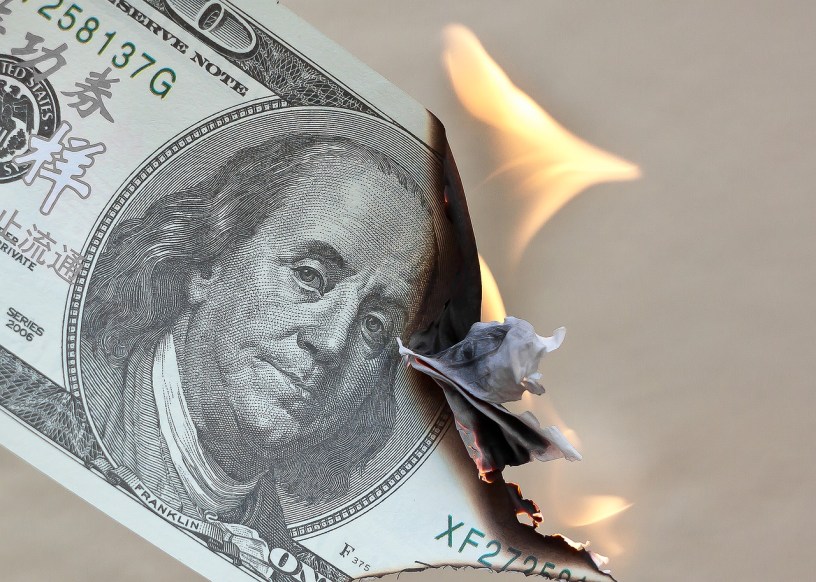
For the FIRE investor, inflation is extremely important to take into account. If you’re working, inflation tends to be less of an issue, as in theory, wage increases (which also cause inflation) offset its effects. As long as your wages go up over time at pace with or greater than the rate of inflation, you won’t feel an impact, except after twenty years when you think back and say, “when I was younger, these were a nickel!” (See photo above).
When you’re not earning wages (or you’re not earning as much in wages), inflation can have a tangible impact on your purchasing power. Say you’re able to save $2 million by age 40 and want to retire. That’s a valiant effort worth celebrating. But if you project that you’ll live to 80, you have to account for the fact that your cost of living will increase quite a bit over that time.

Assume that you budget your expenses well and decide that you can spend $4,000 per month, or $48,000 per year. That seems comfortable. By doing straight math, with $2 million in the bank (assuming no growth for now) and spending $48,000 per year, you could theoretically have enough for 41 years. Assuming you don’t outlive your expectation (a morbid goal, but this is a hypothetical), you’d make it without running out of money.
Except that this calculation isn’t realistic. Even if you assume about a 2% inflation rate (which is probably on the low side), in 20 years, you’d need about $5,950 per month just to continue purchasing the same things that your $4,000 per month got you when you started. That’s $6,550 per month five more years later. If you continue to purchase essentially the same things, you won’t make it to 41 years; you’ll make it about 29 years. At that point, you’d have blown through your money.
In these projections, however, we’re not accounting for the fact that you probably won’t take your $2 million (or whatever you have saved) and just put it into a checking account. Instead, as a hedge against inflation – and to continue earning, even in retirement – you’d keep your money invested. Now, you may adjust your portfolio to reduce some of the risk, but you can still assume a return on that money.
Let’s try a more realistic example. Assume a 3% inflation rate and a rate of return on your continuing investments of 5.5%. I know I typically use 6%, but 5.5% would account for an adjustment to reduce risk in retirement. In this scenario, assuming $2 million at age 40, and starting with $4,000 per month in spending, you make it to 80. In fact, at 80, you’ve still got about $6.2 million in market value, so you’re doing fairly well. You could continue to live on using the same assumptions!
With these starting numbers, you can assume an even higher rate of inflation. Assuming you’re able to keep to a budget that starts with $4,000 per month in the first year of retirement, with a 3.5% or even 4% inflation rate, and 5.5% average returns, you have no problem making it into your 80s. This mostly stems from the fact that $4,000 per month is actually pretty low spending – you have to use your own assumed budget to do these calculations. But after housing, car, healthcare, and taxes, $4,000 per month won’t get you as far as it might seem (at least not in the US). Budgeting is one of those things that’s person-specific, so you have to calculate what works for you.

Just for fun, let’s try a few more. If you assume a 5.5% return, 4% inflation, $2 million starting at age 40, and a starting budget of $5,000 per month, you end up making it through age 84 before your balance shows negative. With 3.5% average inflation, you make it all the way to 92, and with 3% inflation, you make it to 100. You can see from this math just how impactful inflation can be on how long your money lasts in retirement.
Rates of Inflation and Market Impact
In reality, inflation – like market returns – is not linear, nor is it really capable of precise calculation. While you may be able to read data about aggregate inflation, inflation does not impact all prices equally. Depending on what you buy, it may impact you quite a bit less or quite a bit more than what the official numbers state. As an example, building materials are often impacted by inflation, and inflation in this sector can push up the overall calculated inflation rate. In a given span of years, however, if you don’t build a new house or do renovations, you may never feel the maximum direct impact of the official rate of inflation.
On top of that, inflation can impact market returns. As you may have witnessed from watching the market, when it appears that inflation may start rising, stocks tend to drop off for a few days. This is typically due to the notion that the Fed will raise interest rates, which lowers long-term growth potential (more or less). While these things tend to smooth out over time, when inflation actually occurs, a few things can happen with stock prices. On the one hand, if there is lower economic growth, it can have a negative impact on the economy. On the other hand, inflation can raise the nominal price of stocks as the market demands a higher price to compensate for the inflation.
So, in some circumstances, if you’re holding stocks while inflation is high(er), their price may actually increase. Theoretically it shouldn’t confer a benefit on you because if the higher price is due to inflation, your purchasing power with that money would stay the same (because of the inflation). But, depending on what you actually buy, there could be value to you. If you’re only buying products with lower inflation, then the boost in stock prices may actually increase your purchasing power.
It’ll always be difficult to know the precise impact of inflation, just like it’s difficult to determine your exact rate of return year over year. Everything has some uncertainty, but the point is that you have to account for it. So, when calculating how much you need for retirement, and putting together a retirement budget, you have to assume inflation will increase your costs on a year over year basis.

How much inflation should you assume? Well, 2.5% to 3.5% is probably a safe/conservative assumption based on the current approach by the Fed.
Where might inflation go in the future? Who knows. If you look back 40 years, you’ll see much higher levels of inflation, but that was when the Fed took a different approach.
Could this change? Absolutely. But building in something like a long-term rate of 5% to be ultra-conservative is probably not worth it, even despite the fact that inflation did hit this level in 2021. It’d be pure speculation and could derail plans to retire early. If inflation goes up while you’re still saving, then definitely adjust. If inflation goes up and becomes more of an issue while you’re retired, you may have to adjust your monthly budget. But don’t let the speculative prospect of higher inflation undo your plans. Calculate based on what’s reasonable and what’s fairly well known.
But make sure you account for inflation when determining how much you need to save. Inflation is very much real and plays an important role in how you plan for the future.
 The FIRE Investor's Guide to Early Retirement